
A flash of orange, a startled deer, a growl, then teeth and blood—the tiger’s presence is abrupt and dramatic—a cinematic burst of danger:
It is typically encountered from a safe distance, framed in safari literature as a spectacle, on warning signs as a threat, and in news headlines as an object of fear. The prevailing sentiment is a blend of caution and thrill: a powerful creature best avoided. For those in urban settings, the tiger is primarily defined by this distant fear, shaping how it is understood and imagined.
That is not how Tamesh Sonkar learned to see it
Tamesh is from Balaghat district and belongs to the Kalaar community. He grew up within the larger Gond cultural region and now works with us at Earth Focus — a foundation dedicated to community empowerment and education — as an educator and Gond art trainer. He works in villages around the Kanha Tiger Reserve, where Adivasi communities live in forest buffer zones shaped by conservation policy and everyday dependence on forest resources.
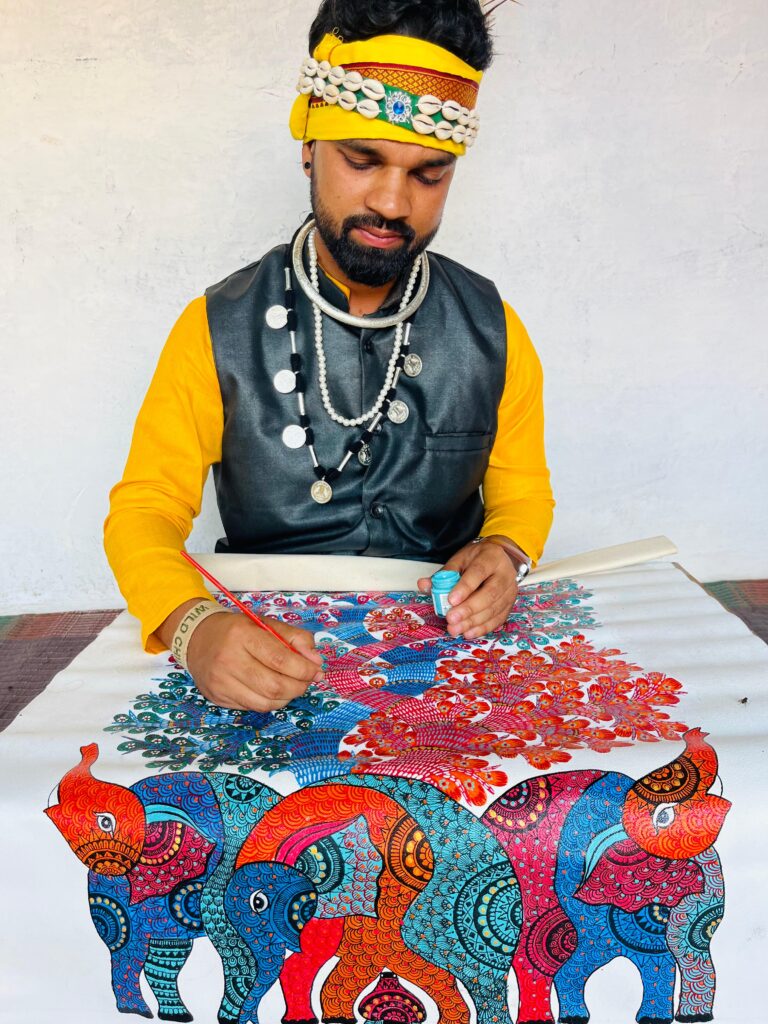
For him, the tiger is neither monster nor metaphor, but another being within the forest’s moral order.
“The tiger eats because it must, just as we eat,” he says. “It is not greedy. It takes what it needs to live.”
This does not mean the tiger is not feared in forest villages — it is. Encounters can be dangerous, and the loss of livestock or life is remembered through generations. But fear exists within a moral relationship rather than as pure spectacle. The tiger is understood as another being seeking subsistence, not as a creature outside the ethical order of the forest.
In Gond symbolism, animals are rarely neutral. Tamesh explains that the baarahsingha (swamp deer) is associated with balance, prosperity, and natural abundance, while the baagh (tiger) is associated with strength, courage and protection
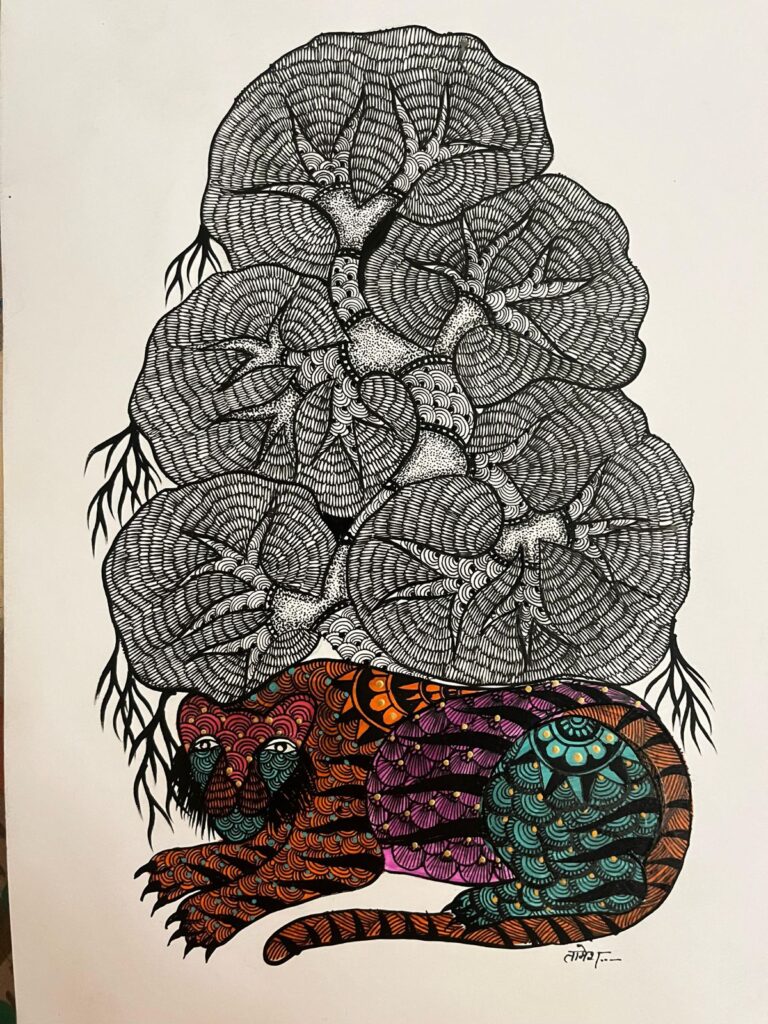
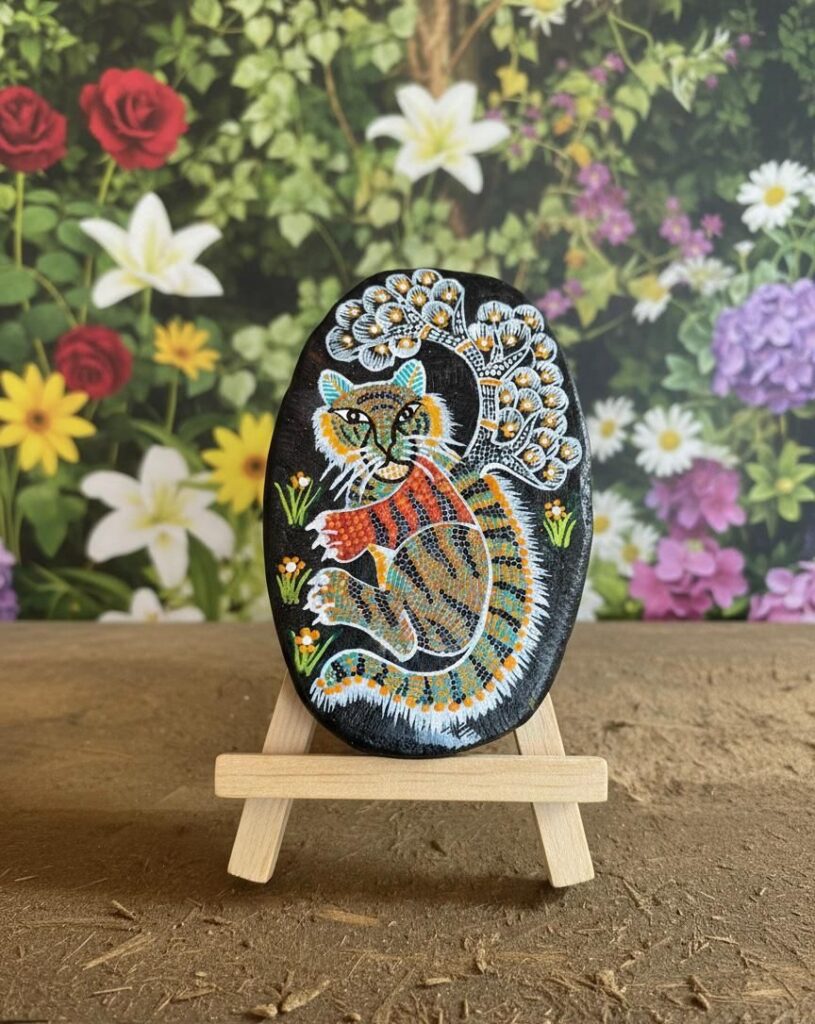
These meanings are carried not only in speech but in image. In the paintings of artists such as Jangarh Singh Shyam — who carried Gond art from forest villages to national and international galleries — the tiger appears not merely as prey or predator but as a lord of the forest, a guardian spirit. Its body is filled with fine dots and lines that resemble seeds, feathers, bark and leaf veins, as though the forest itself has entered its skin. Trees rise along its spine; birds appear beside its tail. Deer do not flee its form; they share it.
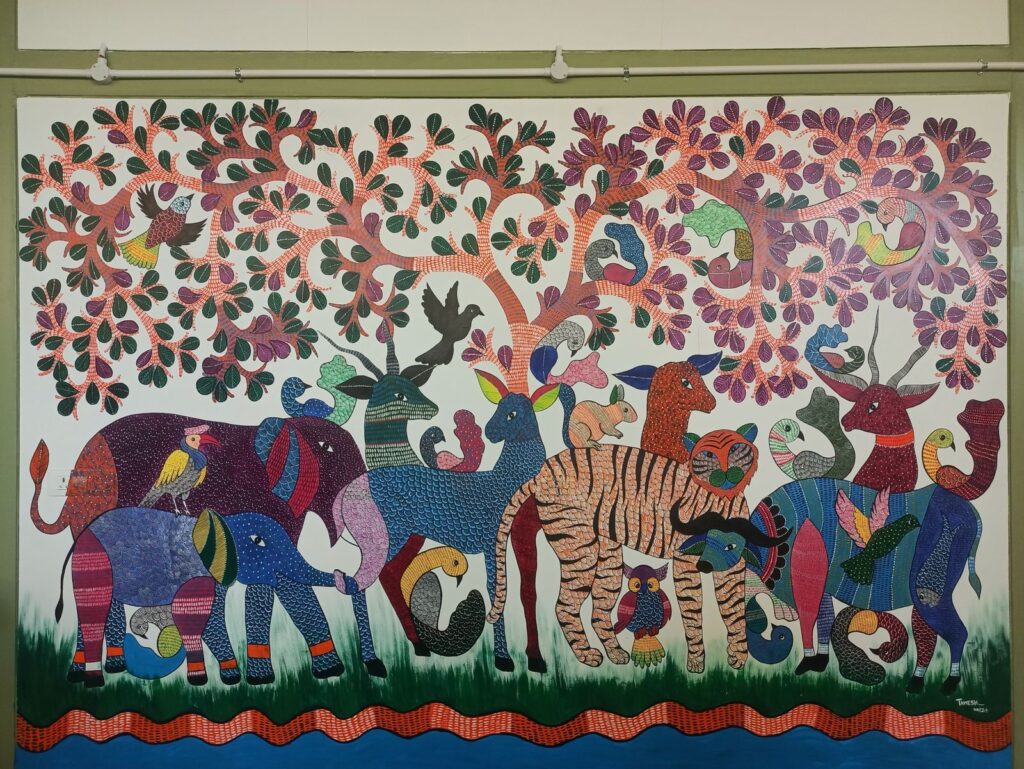
Mahua and saja trees are often present. Crow, deer and human figures occupy the same breathing space. There is little separation between background and foreground. Everything belongs to the same living field. The tiger becomes an element rather than merely an organism.
In Venkat Shyam’s “Tiger God with Five Senses,” the animal appears as a cosmic being: fire runs through its reds and oranges, water through blue veins, earth through grounded browns and greens, air through flowing lines and space through the absence of borders.
Where contemporary conservation often treats the tiger primarily as a protected species — to be monitored, managed and counted — Gond art places it back into relationship. The animal is not extracted from the forest to become a symbol. It remains embedded in a wider moral and ecological field. The tiger is not an image of conquest. It is an image of coexistence.
The Fading Colours of Tradition
Today, while enormous attention is directed toward the tiger as an endangered species — and extensive measures are taken to conserve it — what is quietly becoming endangered is the Gond art form itself.
Tamesh remembers watching his uncle paint when he was a child. Colours did not come from shops. Black came from charcoal and soot, red from red soil and crushed lal mirch, white from chuna, yellow from turmeric and certain clays, green from crushed leaves and plant extracts, and browns from bark and seeds. Brushes were made from twigs, feathers or cloth.
Today, Tamesh says, only a handful of people in the tribal community of Kanha still know how to paint in the Gond tradition. The knowledge that once passed naturally within families has thinned to a small number of practitioners. Pressures of migration and livelihood insecurity have steadily eroded the conditions in which the art once thrived. People leave their villages for work, struggle to secure daily survival, and no longer have the time or space to practise or transmit these traditions. Gond painting, once embedded in ritual and domestic life, is increasingly treated as optional — even expendable.
This is where cultural preservation becomes a vital livelihood strategy. If the art is not valued as a skill that can support a family, it will vanish.
Earth Focus now works across 39 villages around the Kanha Tiger Reserve, each with a primary school serving forest-edge communities. Children growing up in the buffer zones of Kanha increasingly encounter conservation through boundaries, warnings and restriction rather than through inherited ecological knowledge. Without deliberate cultural transmission, both artistic practice and relational forest knowledge risk disappearing from everyday learning.
This makes the present moment critical: the generation that still remembers how these stories were drawn is now teaching the generation that would otherwise inherit only absence.
Masti ki Pathshala: Art as Pedagogy
Through its work in the schools of Kanha, especially in evening learning spaces such as “Masti ki Pathshala,” Earth Focus integrates Gond art into everyday learning rather than treating it as an extracurricular activity.
Tamesh joined Earth Focus as a Shiksha Prerak (Education Motivator) and later became an educator. Recognising his interest in art, the organisation supported him to train professionally in Gond art in Bhopal for six months. He received a government-recognised artist ID — rare for someone from his region.
On returning, he began training a team of 10 educators in Gond art, who in turn mentor Shiksha Preraks working in 39 village schools and evening learning spaces. Through this cascading structure, Gond art enters classrooms not as decoration but as pedagogy, shaping how children learn to see animals, forests and themselves.
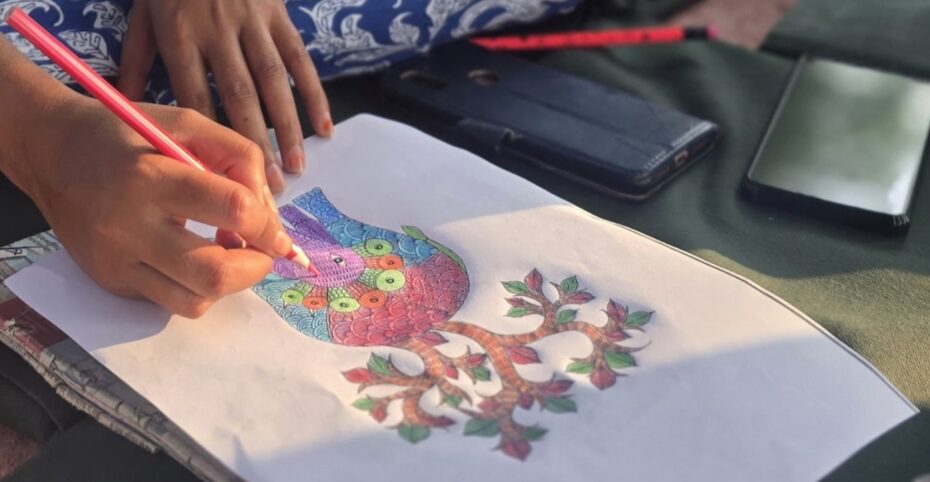
Within Earth Focus’s “Masti ki Pathshala,” Gond art is taught to children and mothers through drawing, storytelling and shared making. Learning takes structured form through a sequence of image-based activities.
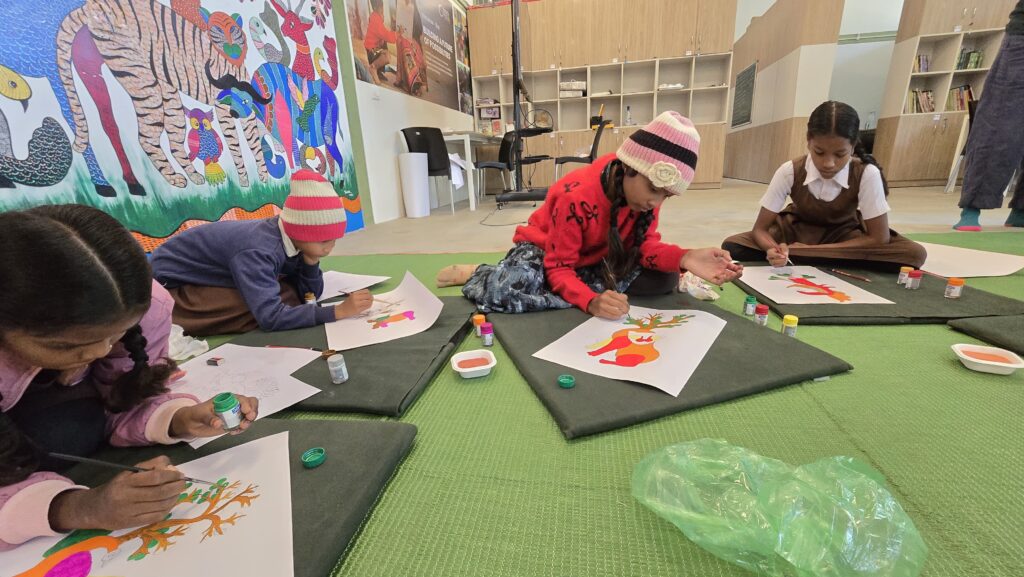
Children work with patterns and symmetry by completing half-figures and filling shapes. They practise line control through step-lines and basic object drawing. They listen to stories and translate them into pictures. They create scenes of forests, animals and village life using circles, triangles and lines. Printing with leaves, vegetables, fingers and blocks connects art to everyday materials and to the forest itself.
These exercises develop fine motor control, visual reasoning, narrative thinking and confidence in self-expression, while remaining rooted in local ecology and culture rather than imported classroom imagery. In expressive arts pedagogy, such image-making is understood as a way of externalising inner experience rather than merely reproducing objects.
Historically, Gond art was painted on walls and floors using natural pigments. Today it is made on paper and canvas with acrylics and poster colours. Children paint animals, trees, birds and village scenes. New themes — deforestation, schooling, social change — also appear. Yet the dot-line grammar remains, allowing continuity within transformation.
One drawing that stayed with Tamesh was made by Ashish Saiyam,11. He drew a sun in the centre, flanked by two forests — one green and full of life, the other dark with cut trees. When asked what it meant, Ashish said the green forest showed how the forest once gave them everything — food and shade — while the black forest showed what happens when trees are cut without care.
“The forest is becoming wounded,” he said.
Through form and colour, the child articulated ecological change and moral concern. This is where aesthetic literacy overlaps with socio-emotional learning. Art becomes a way to hold memory, loss and responsibility in the same frame.
In 2024, an exhibition in Ahmedabad featured works by 13 children from these forest villages. Each received a certificate — small documents, heavy with meaning. For many, it was the first time their drawing crossed the boundary of the village and entered a public space of recognition.
Looking Ahead: From Classroom to Career
Through Earth Focus’s work, Gond art becomes both curriculum and continuity. However, for this revival to last, it must evolve into a viable economy.
Future partnerships are needed to weave this cultural learning into a sustainable livelihood without extracting it from its ecological context. Investing in this programme restores dignity to a form once pushed to the margins and gives children a language — visual, cultural and moral — to make sense of the world they inhabit.
While the tiger roars in the deep zones of Kanha, in the Masti ki Pathshala it is quieted into dots and lines. It becomes more than an animal — it becomes a lesson in strength, coexistence and the dignity of knowing where one comes from.
Join us in preserving this vital heritage. To learn how you can support the next generation of Gond artists, visit [https://earthfocus.in/].