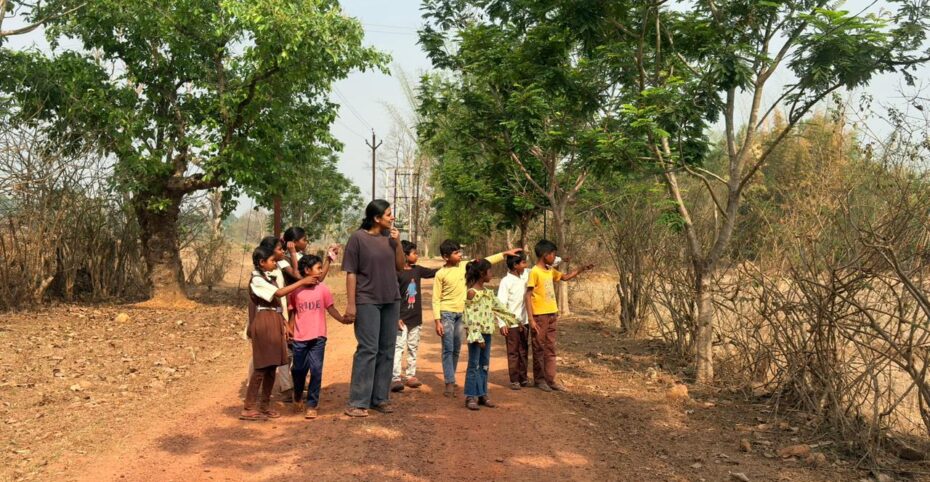
“I have fallen completely in love with Kanha. Ab toh mujhe baahar hi nahi aana,” Shikha says. She isn’t quite speaking; she is almost singing, as though the forest itself taught her the rhythm
Shikha comes from Haryana’s Hisar Jat community, a family of teachers from the agrarian plains. She was the first girl from her village to complete a master’s degree, leaving home for Chandigarh—Le Corbusier’s city of straight roads and numbered sectors. She studied zoology and trained as a teacher with the Azim Premji Foundation. But what drew her into biodiversity education wasn’t the romance of the wild.
It was a troubling question: Why were children growing distant from the living world around them?
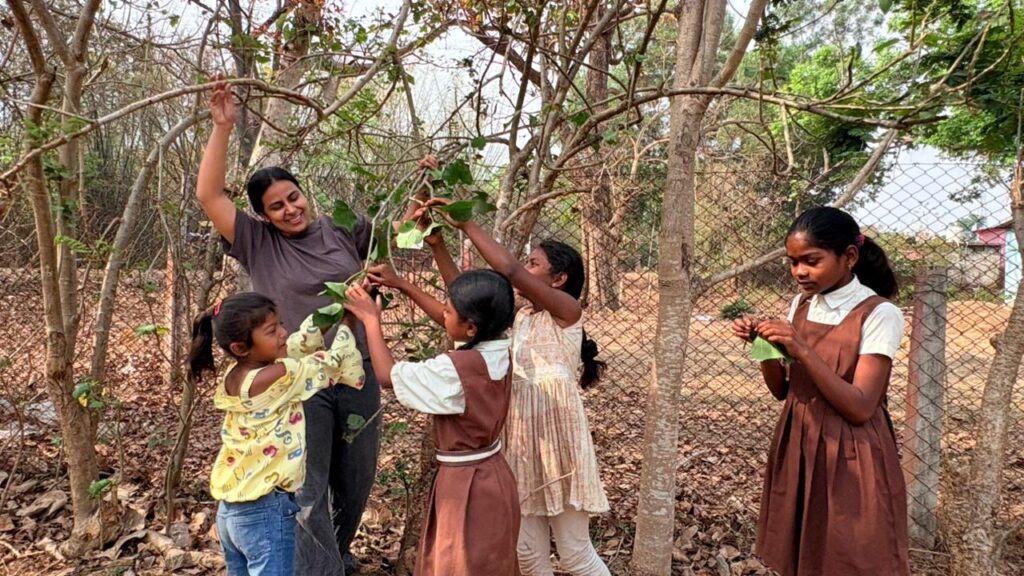
Shikha began noticing “plant blindness”. Children could no longer name the trees they passed daily; they couldn’t distinguish one leaf from another. Insects were things to flee from, and plants were merely background. For Shikha, biodiversity wasn’t just a subject; it was a relationship. It would only matter to the future if children learned to see themselves as part of it—not looking in from the outside.
When the opportunity arose to work with the Earth Focus Foundation as a biodiversity curriculum designer for the indigenous tribal children in Kanha, she agreed immediately. This was where her concern for learning and her love of living systems could finally meet.
Learning in Place
In the Kanha region of Madhya Pradesh, Adivasi and rural communities live along the edges of the Tiger Reserve, sandwiched between the forest and cultivated fields. It is here that Earth Focus runs its child development programmes.
The work began in 2019 with Anand Ghars, bringing Hindi and mathematics to primary schools. By 2020, the initiative extended into anganwadis, and later, English classes were added. The biodiversity curriculum followed as a natural extension.
Crucially, the programme was designed around the children’s existing lives, not against them. Since government schools function from 11 a.m. to 4 p.m., Anand Ghars open their doors early, from 8 a.m. to 10:30 a.m.. In 2024, Masti ki Pathshala was added in the evenings—a space where children stay back to paint, dance, and listen to stories.
These aren’t just remedial sessions. They are spaces where learning loosens its grip on “correctness” and makes room for confidence. Over time, the team realized that teaching children about the forest without teaching them where they stood inside it was incomplete.
The Day a Story Met a Tree
The children knew at once that Shikha was not one of them. Like the forest guards and researchers who passed through, she was another adult from the outside carrying lessons from elsewhere.
The distance shifted the day a story met a tree.
Shikha was reading from an NCERT Barkhaa book titled “Jhoola,” a story about two children who find a discarded tyre and turn it into a swing.
The class burst out laughing. Why, they asked, would anyone need a tyre when the banyan trees already offered a perfectly good jhoola?.
They took her to the Bargad (banyan) by the Banjar River, pulled down a low branch, tied it to another, and fashioned a swing on the spot. Then they refused to let her sit on it—teasing her that she might fall.
From that moment, the lessons moved outward. The children showed her bamboo traps and rope-lowered baskets for fishing. They explained how stone bunds slowed the river’s current. They introduced her to the mahua tree—how its flowers are gathered at dawn to be dried, ground into flour, or fermented.
It became clear that these children already carried a detailed map of the forest—not on paper, but in habit and memory.
When Knowledge Stops Counting
The elders in Kanha speak of a time when the forest was enough. It wasn’t a life without hardship, but it was a life where work, learning, and survival belonged to the same system. Knowing which leaf healed and which branch fed the fire was the education.
In that worldview, the tiger was not a headline. It was simply another presence in the same breathing system of trees, insects, and humans.
Conservation, however, is often spoken in a different language.
-
- What was once lived with becomes something to be managed.
- What was once sacred becomes something to be counted.
- Connection turns into conflict.
When a way of living is repeatedly described as a problem, it begins to feel like one. A generation learned that the place which fed them was something to step away from, and that “progress” lay in towns without bird calls.
Turning Experience into Curriculum
In Kanha, children learned to read the forest long before they learned to read print. They noticed pugmarks and bent grass, scat and bird calls. They learned risk by reading water and movement, not by memorising road signs.
Shikha and the team realized that the question was not what to teach, but how to recognize what the children already knew.
At first glance, the idea raised an obvious doubt: If children already live in the forest, why do they need a biodiversity curriculum at all?
The answer lay in the difference between living inside a system and seeing it clearly. The curriculum did not replace their knowledge; it gathered it into language, pattern and reflection. It turned experience into understanding. When tracking, seasons and animal behaviour were named as observation and pattern, science no longer arrived as something foreign. It became a way of recognising what they had already been doing.
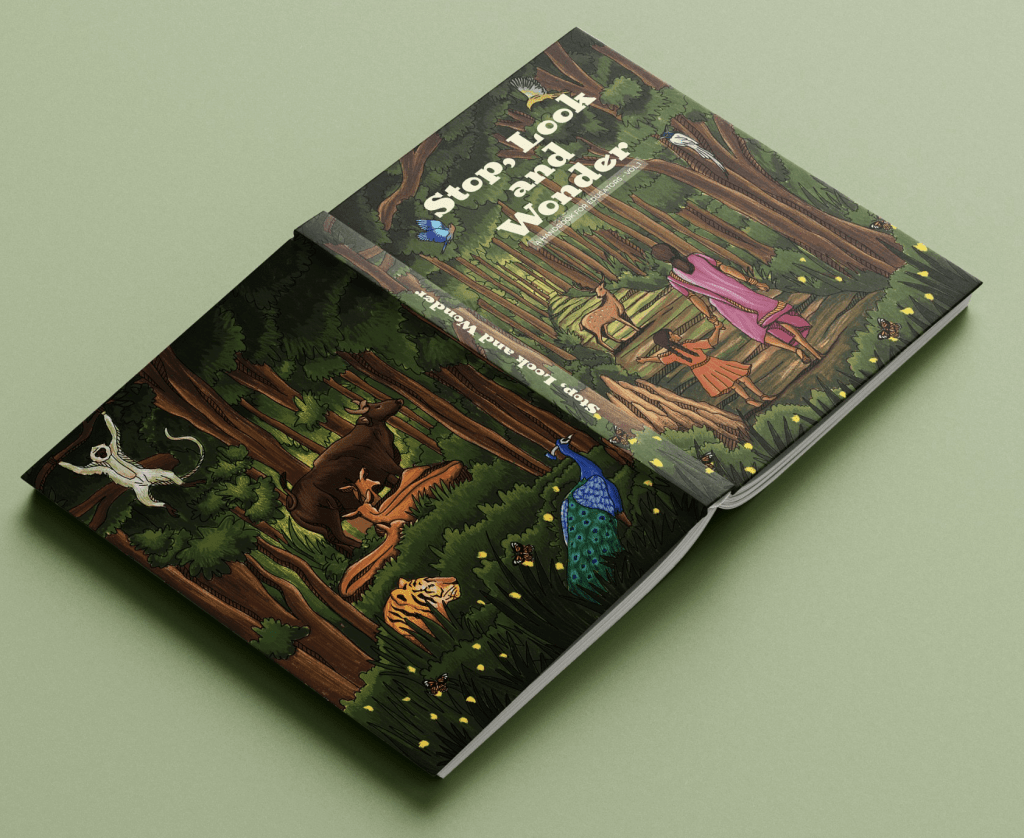
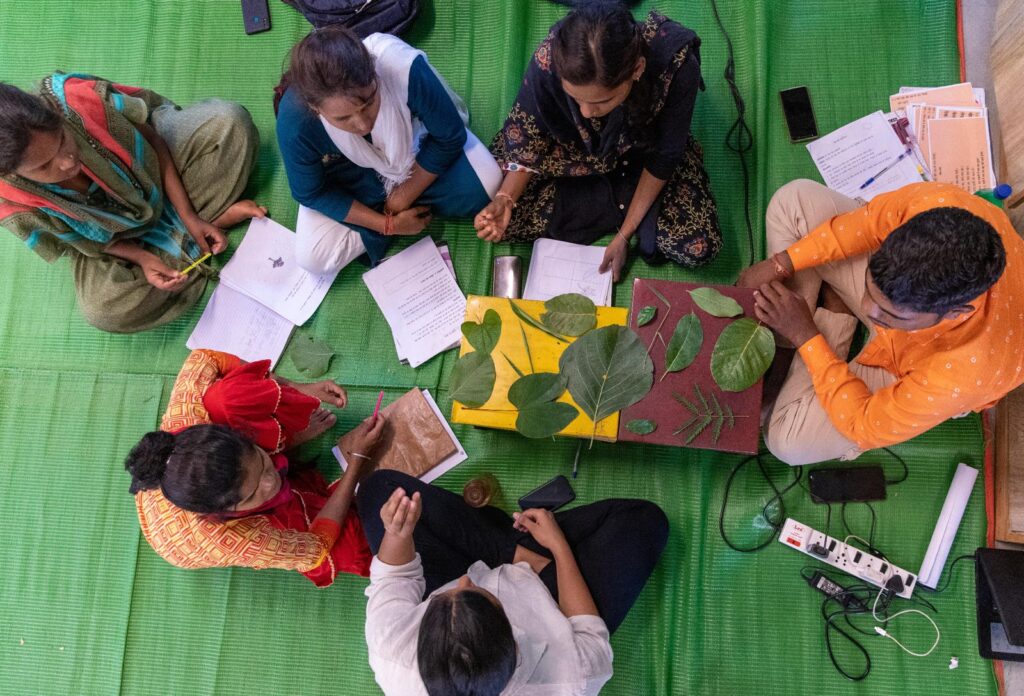
In 2024, this approach was formalized into the “Stop, Look and Wonder” biodiversity curriculum. It doesn’t replace local knowledge; it gathers it into language and pattern. When tracking animals or observing seasons is named as “science,” it no longer feels foreign.
-
- Geography enters the classroom through maps of their own landscape: the core forest, buffer zones, and revenue villages.
- “Our Home” asks what it means to belong to a forest village rather than a street.
- “Exploring Soil” transforms farming from a chore into a living process.
- “Life of Mahua” unfolds the cultural meaning of a familiar tree.
Why This Matters Beyond Kanha
Kanha is only one forest. Across India’s buffer zones, children grow up between two worlds: one shaped by land and seasons, the other by textbooks and exams. Too often, they are taught that only the latter counts.
The experience in Kanha suggests a different possibility: that schooling can be shaped by the ecologies children actually inhabit.
Already, this approach is spreading. The Wise Bridge Trust, working with the Van Gujjar community near Rishikesh, has begun using the curriculum. Educators near the Tadoba Tiger Reserve are doing the same.
There is room here—like the shade beneath a flowering mahua—for more people to gather. Whether you are an educator, researcher, or partner, the forest is open.
For readers who wish to explore the curriculum, please click Stop, Look and Wonder.