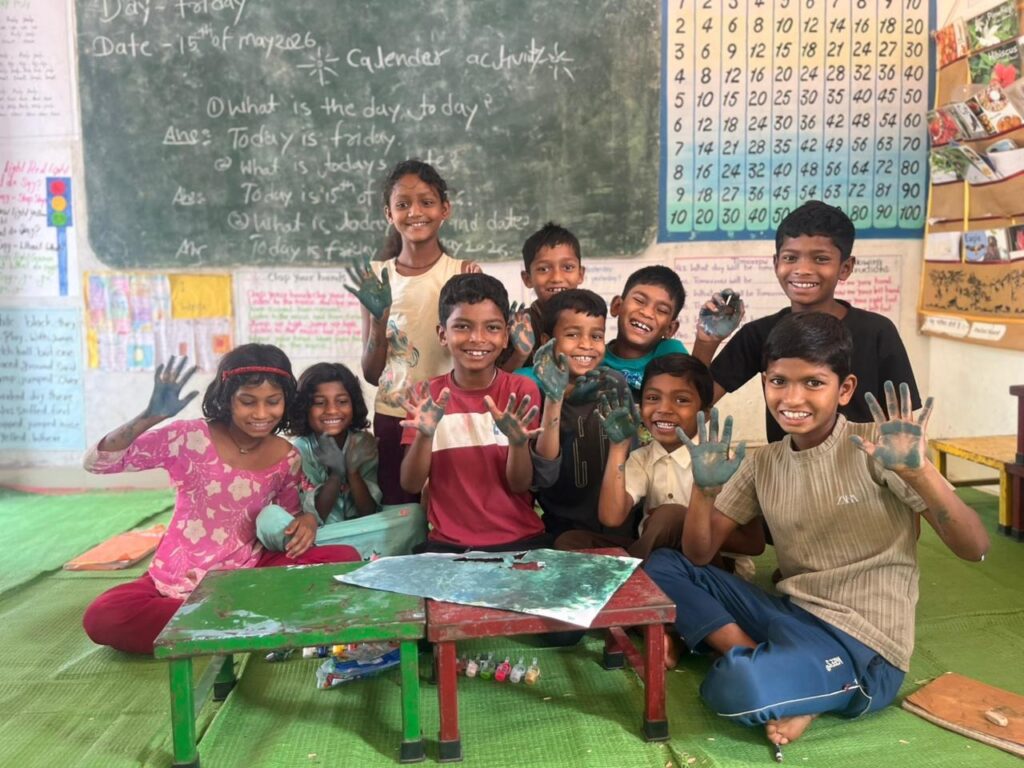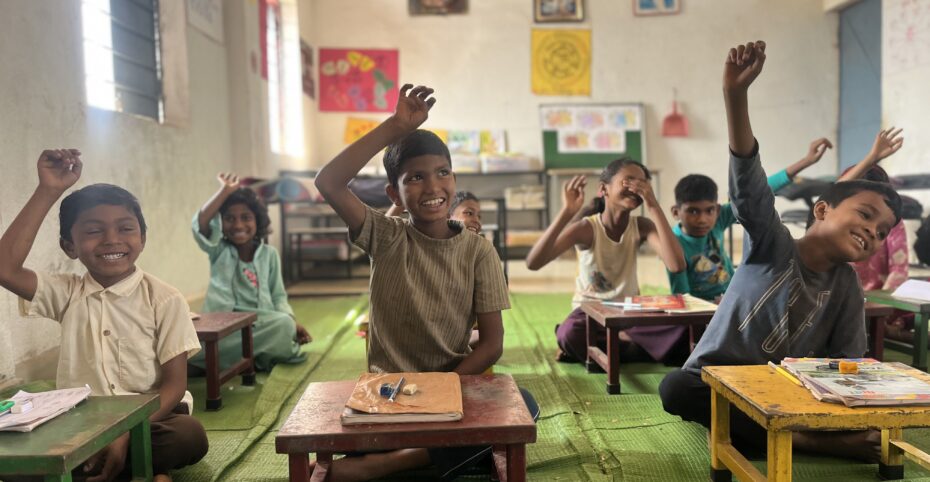
The Playground buzzing with Activity
In the middle of the school’s playing field, two children sit opposite each other, focusing intently on a plastic bottle positioned between them. Surrounded by a circle of their peers who clap and shout guidance, the atmosphere is electric. An early attempt by one player to grab the bottle sparks a quick outcry from the group. At the final signal, both children lung forward, creating a swirl of dust as they compete for the prize.
Close by, an older pair of students quickly pause their own play to assist a younger child who has tripped. They help him up, brush the dirt from his garments, ensure he is uninjured, and then promptly return to their game.
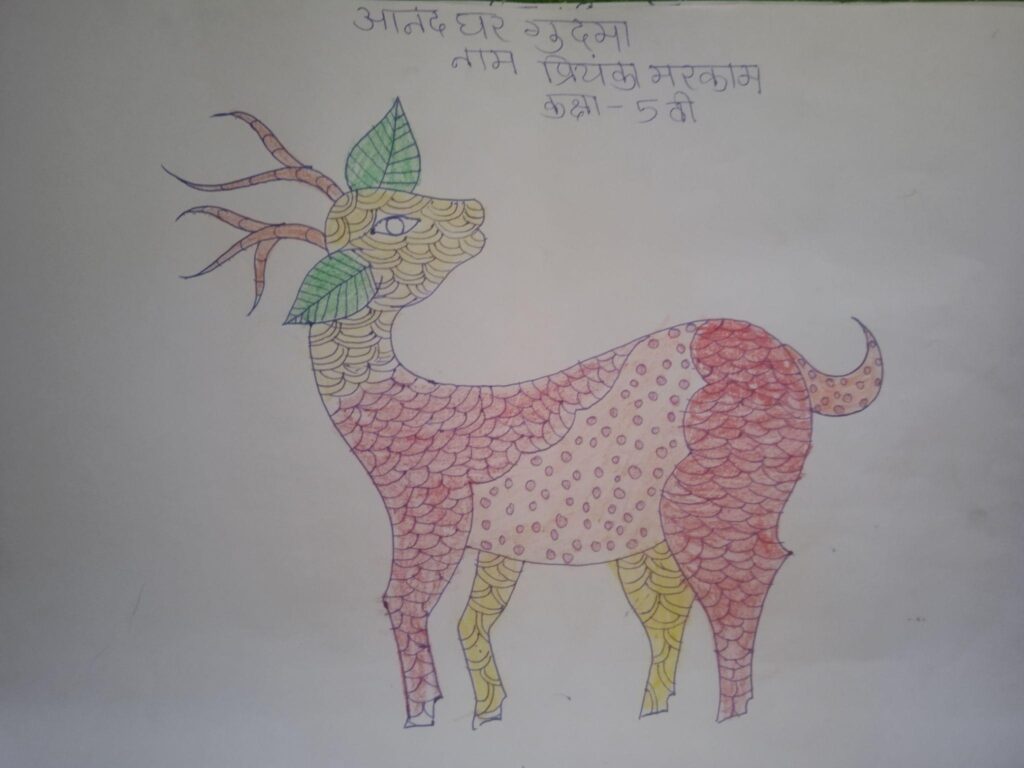
Meanwhile, near the school building, a group is engaged in artistic recycling, decorating old bottles gathered from local households. One creation features a deer adorned with green motifs, while another depicts a series of trees encircling the glass.
Nearby, other children are focused on music, working together to master a specific line of a song and frequently pausing to help one another get the melody just right. A few children nearby are trying to repeat the same song line together, stopping every few seconds to correct each other.
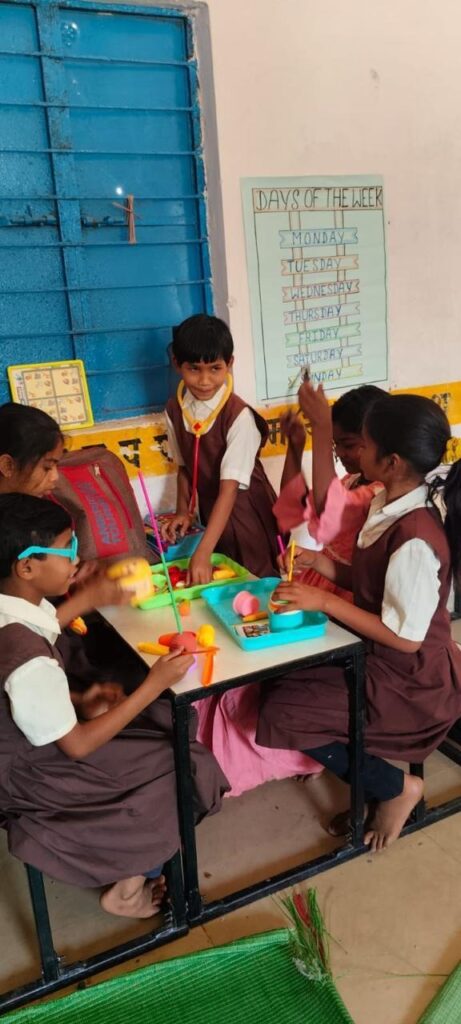
In another corner, a group of girls are busy with a toy medical kit. One adjusts a plastic stethoscope around her neck while another takes notes on a scrap of paper, waiting for her turn to examine the next patient. A third sits patiently on a bench, answering questions about an imaginary fever.
Formal classes ended hours ago. But the school grounds are still full. And the learning continues.
This is Masti Ki Paathshala.
The Evolution of Masti Ki Paathshala
In 2019, the Earth Focus Foundation initiated its pedagogical journey within the rural landscape bordering the Kanha Tiger Reserve.
The inaugural effort took shape as Anand Ghars—dedicated environments established to bolster the basic literacy and numerical skills of students attending local state institutions.
By eight o’clock each morning, children would emerge from the fields, traversing narrow dirt paths to reach the centres. In the hours before the formal school day commenced at 10:30 a.m., these spaces hummed with activity as groups congregated for storytelling, mathematical exercises, and shared reading.
The scope of the work eventually broadened, encompassing anganwadis and English instruction before integrating biodiversity studies that explored the intimate ties between local geography, forest cycles, and seasonal shifts.
By the tail end of 2024, a new routine had emerged. Long after the final school bell rang at four in the afternoon, the children remained on the grounds. Play took over, and the sound of singing began to drift across the village landscape.
This movement, which originally germinated in just four schools, has since flourished. Currently, the Masti Ki Paathshala programme is active in approximately thirty-six schools throughout the territory.
Learning Through Art, Observation, and Imagination
From its inception, creative expression has been woven into the fabric of Masti Ki Paathshala, with Gond artistic traditions serving as a pillar of the learning journey.
Rather than jumping straight into elaborate forest panoramas, the children progressed through a measured, incremental process. This journey began with the mastery of fundamental strokes—circles, curves, and rhythmic patterns. Through repeated free-hand practice, students developed the confidence to render shapes without the aid of tools. Only then did the curriculum transition to the living world: first birds, then the shimmer of fish, followed by deer, and eventually the architecture of trees.
At the start, many found it difficult to capture the flora and fauna of their surroundings on paper. To bridge this gap, facilitators led them beyond the classroom—along dusty village tracks and into the quiet margins of the forest. Children paused to observe the intricate textures of bark, the geometry of nests, and the way branches reach toward the sky. They returned from these wanderings with sketches and a new sense of curiosity.
Slowly, the nature of their work began to shift.
Artistic subjects no longer stood in isolation; birds were perched in branches, and fish navigated rivers that flowed past forest edges. Deer gathered near water, and human figures began to appear within these seasonal landscapes, illustrating a shared existence.
The scope of exploration grew to include leaf and vegetable printing, natural textures, and the assembly of collages. Some sessions challenged children to visualize oral histories, while others invited them to depict the village under a setting sun or the stillness of a night sky.
Canvas was found in unexpected places—discarded bottles, smooth stones, and scraps of cardboard salvaged from the community. These creations became more complex, vibrating with stories, observations, and deep-seated ideas about the world they inhabit.
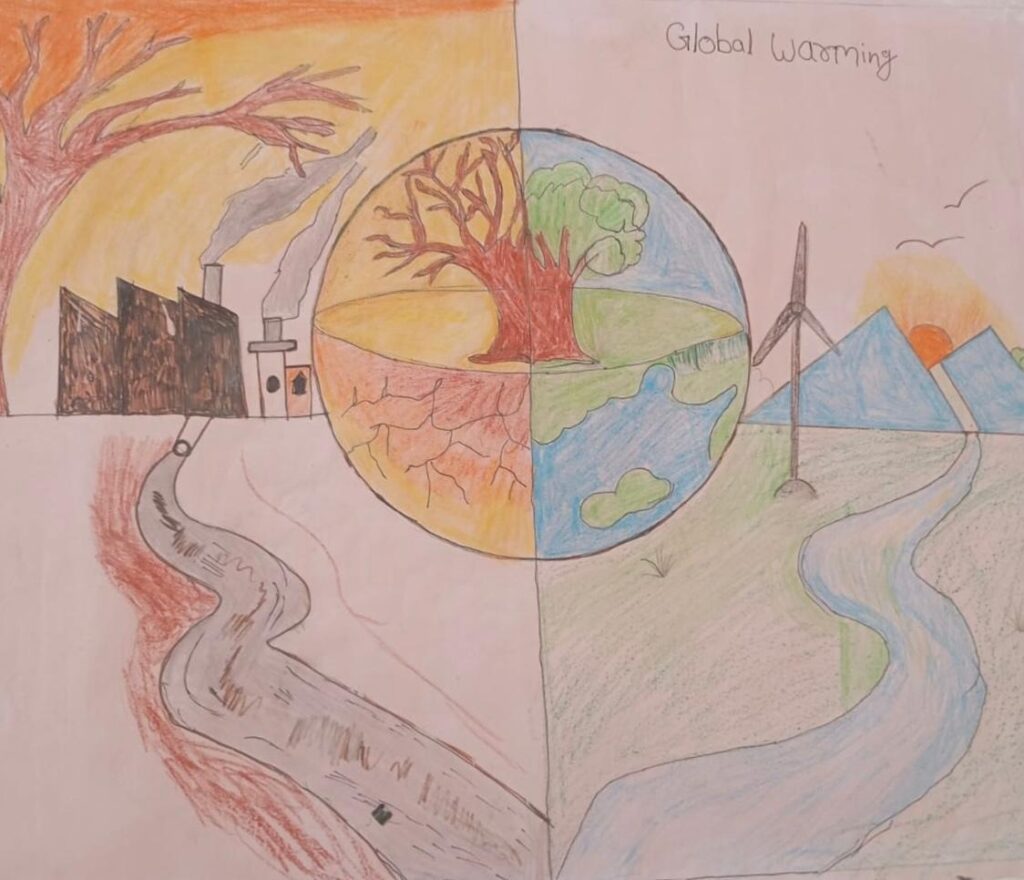
Eventually, the children’s imagination reached beyond the visible horizon. Alongside familiar forest scenes, drawings of urban expansion and shifting climates began to emerge. In one striking image, a child contrasted a parched, industrial landscape with a vibrant world of rivers and wind power, adding the simple label: Global Warming.
Questions That Did Not Come from Textbooks
What children were doing in the art sessions began appearing in biodiversity classes as well.
In Kanha, forests shape food practices, seasonal rhythms, ceremonies, work, and memory. Masti Ki Paathshala encouraged children to look more closely at things they already encountered in everyday life.
One afternoon, while drawing mushrooms, children began discussing the varieties they found near the forest.
“How do you know which mushroom is safe to eat and which one is dangerous?” “How do people even know this?”
Children drew on what they had seen themselves and what they had heard from parents and grandparents. Some insisted colour alone could not be trusted. Others argued that smell mattered more.
On another evening, children sat comparing leaves collected from nearby trees.
“Why are some leaves round?” “Why are some oval?” “Why are some long?” “Why do different leaves smell different?”
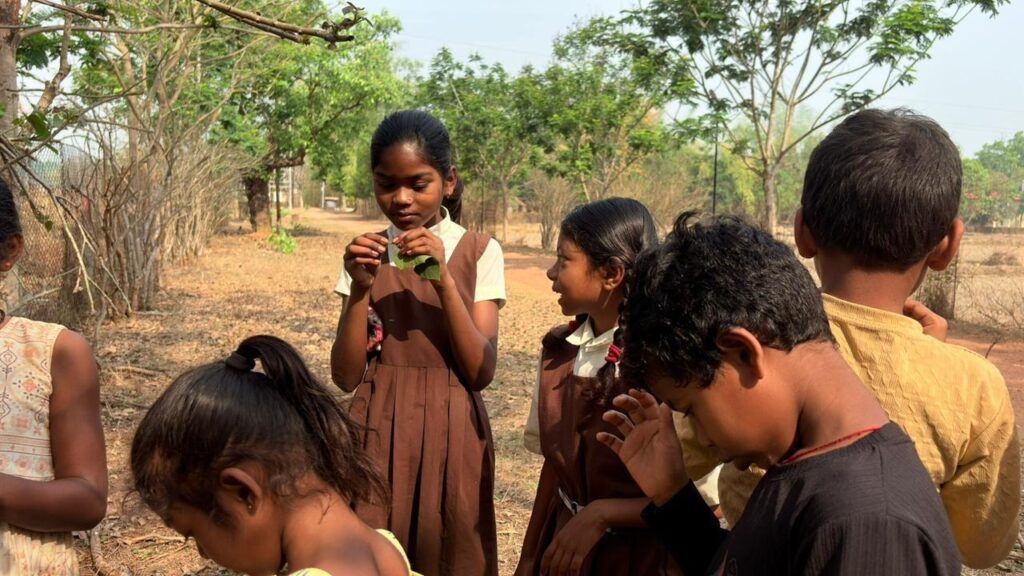
The children were not responding like students answering classroom questions. They were speaking from familiarity. The forest already existed inside their vocabulary.
The same close attention that helped children draw a bird, a tree, or a forest scene was also finding its way into conversations about mushrooms, leaves, insects, water, and the relationships between living things.
Learning Through Play, Dance and Music
Traditional games such as Kho-Kho, Kabaddi, Langdi Tang, Chain-Chain, and Rassa-Kassi remain central to Masti Ki Paathshala. In Ball in the Circle, teams pass a football rapidly between players before trying to place it inside a bucket several metres away. In River Bank, children must instantly move from one side to another as instructions change.
Children run, jump, balance, shout instructions, argue over rules, and reorganise teams mid-game. Yoga and exercise sessions also form part of the programme.
Dance and music, too, have their place. Children are introduced to forms such as Suaa, Karma, Shaila, Baiga, and Dhemsa, traditions practised across Gond and Baiga communities.
As participation grows, parents and elders gradually become part of the sessions as well.
Mothers join the song and dance activities. Elders narrate stories associated with festivals and rituals. Conversations move easily between children, educators, and community members sitting together near the edge of the playground.
One facilitator described the process simply:
“The curriculum is organically growing out of community life itself.”
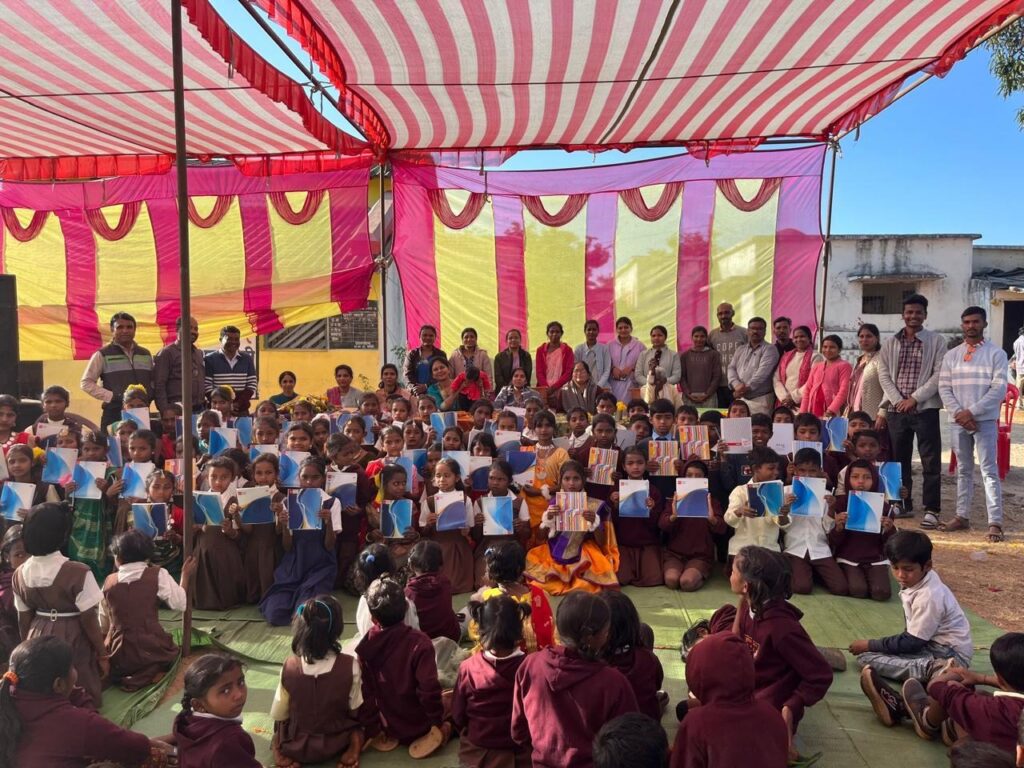
Tribal rituals and ceremonies become part of discussions. During one activity, children collectively explored the sequence of rituals associated with birth. At another gathering, older villagers discussed festivals that have nearly disappeared from regular practice. Songs lead to stories. Stories lead to discussions about forests, festivals, rituals, and village life.
Educators also notice changes in how children participate. Older children instinctively help younger ones during games. Different children take charge depending on the activity. Children who rarely speak during formal classes often become more confident during group activities. Gradually, the same confidence begins appearing inside classrooms as well.
When Children Begin Shaping the Programme
A striking illustration of the way children started to mold the Masti Ki Paathshala experience centered on a single, humble object: a football.
In instances where the ball suffered damage or went missing, navigating the official school bureaucracy for a replacement or repair often meant enduring several days of silence. The wheels of administrative procurement turned slowly, stalling the momentum of the afternoon.
The recurring interruptions became a source of significant frustration for the young participants.
“These delays are costing us our time to play,” they observed during discussions with their facilitators.
In response, the children established a gulak—a small earthen pot—within the school premises. Visiting parents began making modest, voluntary contributions. Taking ownership of the process, the children managed the ledgers themselves, debating collectively on the appropriate timing for expenditures. When a new ball was required, they were no longer tethered to the pace of formal approvals.
Though the gulak occupied only a tiny space among the activity kits, its presence signaled a fundamental shift in how the children engaged with the initiative.
Rather than waiting for adult intervention, the students formulated a strategy, maintained the financial records, and shared the responsibility of decision-making.
While never formally designated as a Bal Panchayat, the children were already practicing the art of collective problem-solving and taking direct action.
The gulak was the organic fruit of one such dialogue.
And from another, the idea for Anand Utsav would eventually take flight.
Anand Utsav: A Convergence of Community and Celebration
In time, the young participants themselves began to voice a desire for broader expression.
While formal opportunities for music, dance, and theatrical performance were typically reserved for state holidays like Republic Day, the children sought more frequent stages to showcase their evolving skills. They wanted a space where the entire village could witness the fruits of their exploration.
Out of these dialogues, Anand Utsav was born—a monthly festival structured around the arts of oral history, traditional games, and rhythmic performance.
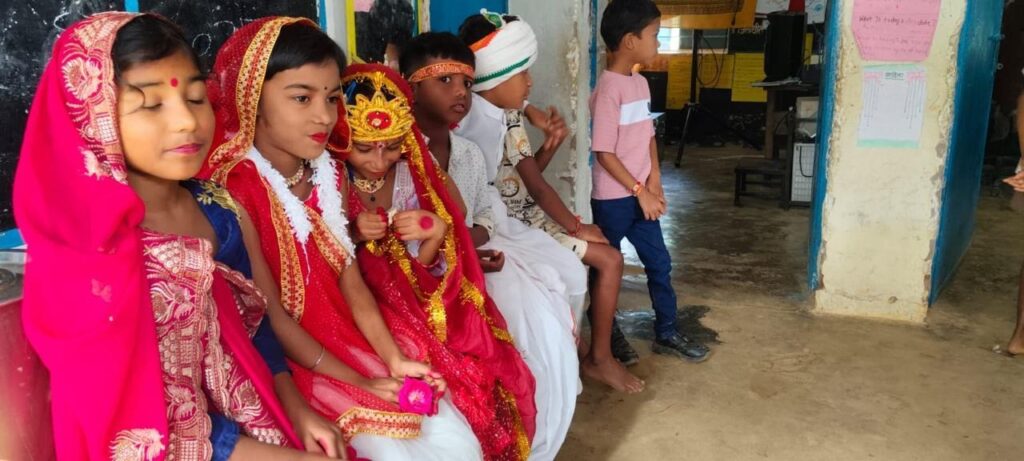
As the sun begins its descent on these festival days, the school grounds undergo a transformation. Classrooms spill outdoors as benches are repositioned under the open sky. Small groups of children practice their harmonies, while mothers standing nearby offer gentle corrections to half-remembered verses. Before long, residents from surrounding villages arrive, gathering to watch as the first performances commence.
At one such event, the air was filled with the song motor gaadi mein jaa rahe hai, a melodic journey that integrated linguistic and cultural echoes from across the subcontinent.
By the time twilight arrives, the distinction between student and spectator often fades, with elders and educators remaining seated together long after the final notes have drifted away.
Much like the communal pot established for playground repairs, Anand Utsav emerged as an organic response to the children’s own vision.
The students had moved beyond merely attending sessions; they were now actively architecting the very rhythms of their learning environment.
What Gets Carried Forward
Masti Ki Paathshala does not attempt to replace formal schooling.
Reading, writing, numeracy, and classroom learning remain central within the schools. What the programme adds are experiences that rarely find much space inside formal lessons — games, songs, stories, local history, ecological observation, art, and time spent across generations.
Along the way, facilitators found themselves returning repeatedly to questions of memory and continuity.
Prashant Parsai from EFF put it simply:
“Traditions survive only when children are taught. Otherwise, slowly, they disappear.”
Through Masti Ki Paathshala, tribal traditions and forms of knowledge that often remain outside textbooks are finding their way back into conversations, performances, and learning activities shared by children, parents, and elders.
For many families, it is not only the songs and stories that matter. It is seeing them treated as something worth teaching.
An elder reflected on this after discovering that local songs, stories, and traditions were becoming part of the educational material:
“I never imagined that our culture, our traditions, our stories, and songs would ever become part of a book.”