
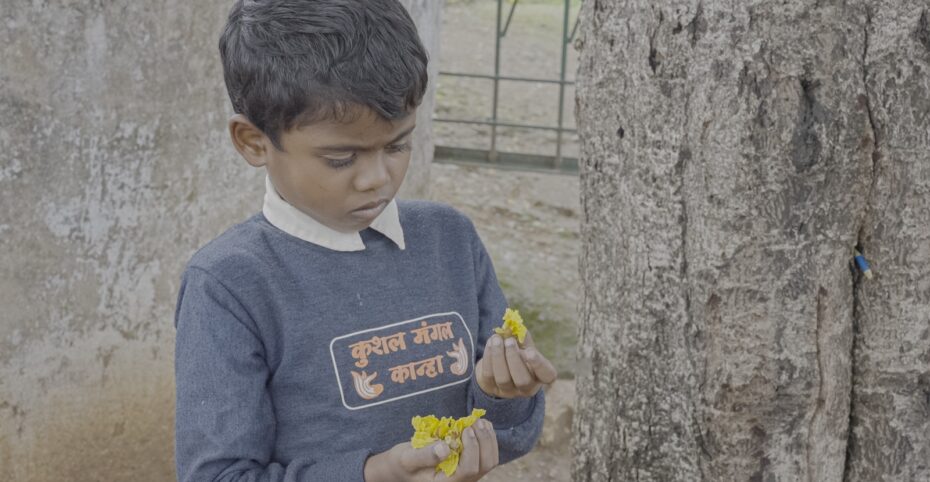
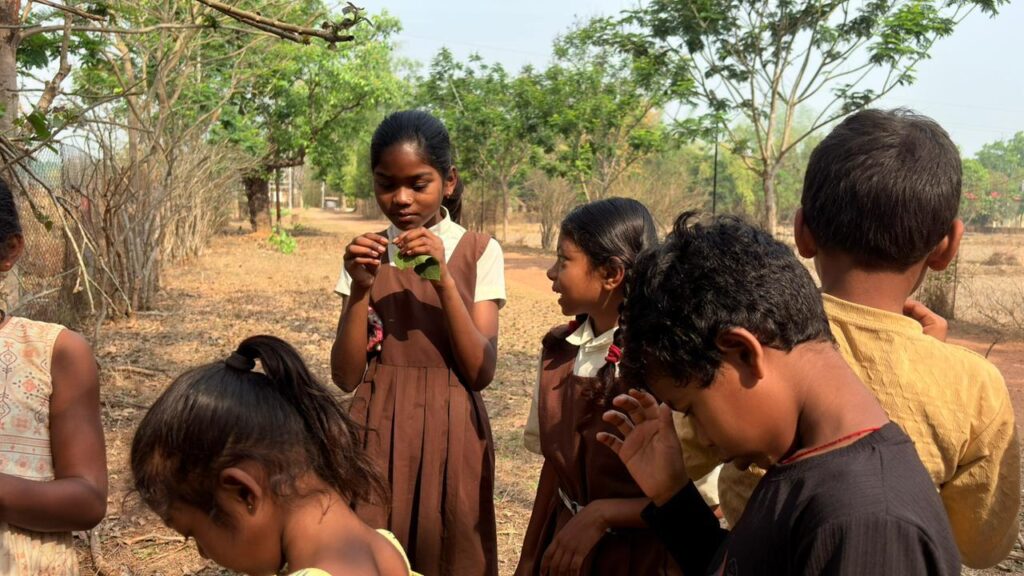
In Basinakhar village, children gathered for the morning Anand Ghar session — a before-school learning programme held at the village school. The day began with the children naming what they knew of the forests of Kanha.
Neem. Mahua. Langur. Tiger. Shikra. Some spoke of what langurs eat. Another pointed to a shikra circling over the fields. A child mentioned that tigers follow deer. Even in those first responses, the children were speaking of connections — between animals and birds, what they eat, and the places they live.
Mayank Markam, one of the children at the session, pointed to a small plant just outside the doorway. “Kukraundha,” he said. “If you put it on a wound, the bleeding stops.” Another child described seeing it crushed and applied to a cut in the fields. A third said it appears after rain. For a while, the children were leading the lesson.
The session is part of a biodiversity curriculum developed by the Earth Focus Foundation (EFF), an organisation working to build a restoration economy in the buffer zone of Kanha Tiger Reserve in Madhya Pradesh. The curriculum currently runs through 39 active Anand Ghars — learning centres that reach 1,307 children between the ages of 6 and 11 through two sessions each week.
The curriculum begins from what children already know, and cannot be separated from the history of these villages.
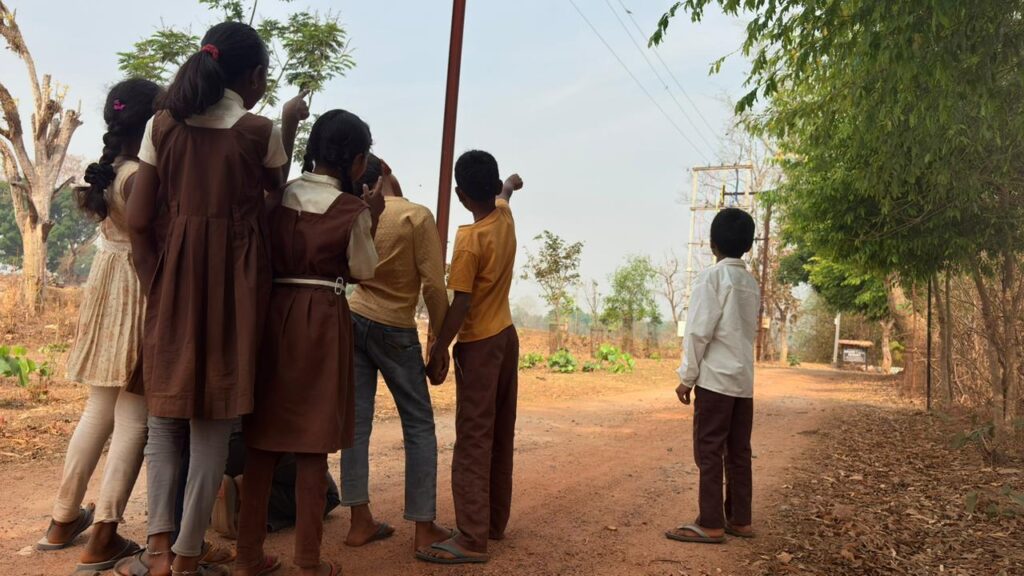
A landscape shaped by conservation, and by leaving it
Most families in the villages where EFF works once lived inside the forest itself. Sorting mahua flowers, walking along field edges, or sitting outside homes after dark, older community members still chat about relocation from the reserve through the late nineteen sixties and early seventies. They reminisce about carrying grain sacks, utensils, and sleeping children while leaving behind houses, fruit trees, and familiar paths through the forest.
The land families received afterwards in resettlement was starkly different. The soil was shallow. Rainfall uncertain. In many places, paddy slowly replaced mixed cultivation on land that struggled to hold moisture through the season. Over the years, people watched parts of the soil dry faster and produce less.
So when EFF later encouraged families to plant mango, bamboo, and other native trees through agroforestry work, some families hesitated. “If the trees come back, will the forest come back too?,” asked some. “And if the forest returned, would we once again be asked to leave?”
Trees meant fruit, shade, birds, and branches to climb. But people remained cautious about planting trees for a long time. Over time, EFF began working with local women and men as Samuday Preraks, or community mobilisers, training them in agroforestry and horticulture so they could help plant and care for trees across the villages. Slowly, families began seeing the cultivated mango, bamboo, and other native trees as a source of future income in places where farming had become increasingly uncertain.
Children in Kanha have inherited the stories of relocation, of a changing land, uncertain farming, and the shift in how families live with the forest. Many are also already familiar with forest paths, animal calls, seasonal changes, mahua collection, water sources, birds before rain, and the sounds and movements of the forest. Many are now growing up around agroforestry work itself — watching parents plant mango and bamboo saplings, water young trees through difficult summers, protect them from grazing animals, and speak about the income those trees may bring in the future.
Why teach biodiversity to children of the forest?
If these children can instinctively read pugmarks in the dust, forage for seasonal produce, and anticipate the monsoons by the flight of birds, why did EFF feel the need to develop a formal biodiversity curriculum for them at all?
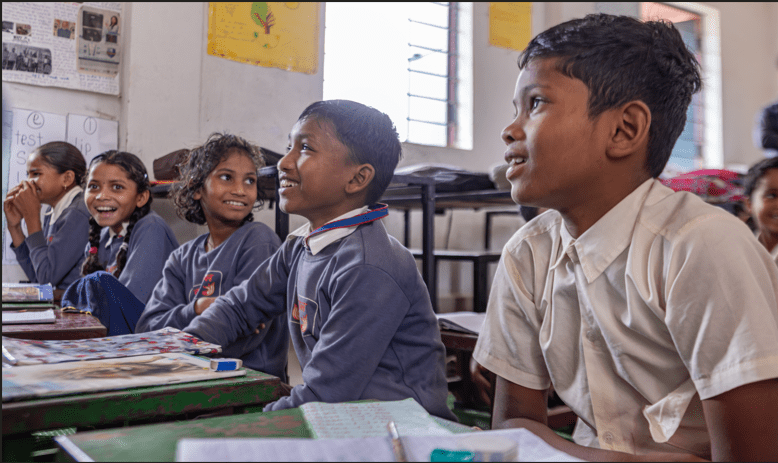
The answer lies in the space between knowing a forest and understanding its invisible, systemic machinery and interdependency. A child raised in a forest-buffer village knows a tree intimately—by the coolness of its shade, the sweetness of its fruit, or the texture of its bark. But a structured lesson shifts the gaze from the tree itself to the web of life it sustains. It asks a different set of questions: Which specific insects pollinate its flowers? How do unseen shifts in groundwater and topsoil dictate its growth? What cascading effects ripple through the local bird and animal populations when a nearby grove is cleared? It moves from mere identification to complex interdependence.
In the buffer villages of Kanha, these are not abstract environmental theories discussed in distant urban classrooms. They are matters of daily survival. A delayed monsoon, the hardening of dry earth, a sudden drop in the yield of mahua flowers, or erratic shifts in animal corridors directly dictate farming outcomes, daily wages, water security, and the myriad vital decisions rural families must navigate throughout the year.
Standard state textbooks and the typical rural classroom rarely leave room for such hyper-local, lived observations. While children might notice shifts in animal behaviour, changes in soil quality, or the sudden drop in the village well’s water levels on their daily walk to school, simply noticing a change does not equip them to explain why it is happening—especially when those changes are increasingly driven by broader climate shifts rather than familiar seasonal cycles.
To bridge this gap, the curriculum steps in. Lessons often ignite from a spark the children have already experienced—something they have disturbed, protected, questioned, or fiercely debated among themselves.
In a school in Gorakhpur, a village near the Mukki Gate of the Kanha Tiger Reserve, a child watching ants march across the mud remarked, “They don’t forget their path.” This simple observation bloomed into a lively argument among the students about how ants navigate.
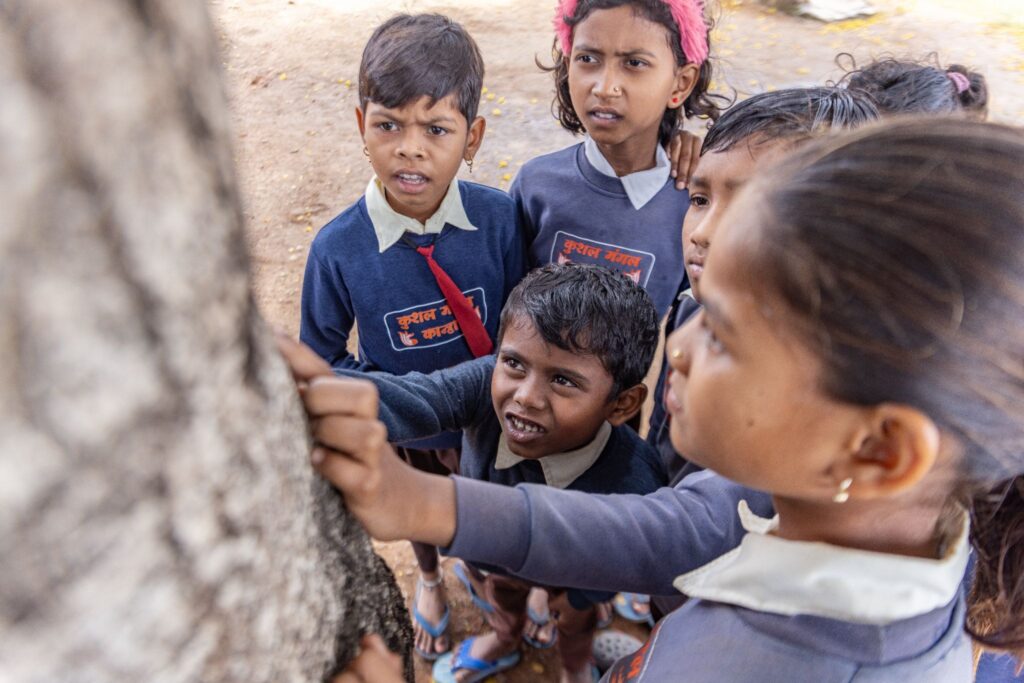
The curriculum harnesses this curiosity, moving from their debate to the science of chemical trails, explaining exactly why the insects can move in unbroken lines without getting lost.
In another instance, children were throwing stones at a weaver ant nest in retaliation for a painful bite suffered while climbing a tree. The educator used the moment to pause the conflict and interrogate the behaviour. Why do these ants defend their territory with such ferocity? What ecological function is lost when their leafy shelters are destroyed, and where do the displaced insects go? The stone-throwing stopped; a lesson in habitat preservation began.
This systemic understanding naturally translates into empathy and action. Elsewhere, after a strong squall brought down a bird’s nest, three children carefully lifted it together, securing it back onto a reachable branch. In another school, when a panicked deer breached the compound walls, the children suppressed the instinct to crowd or chase it. Instead, they stepped back, alerted their educator, and waited for the Forest Department guards to safely intervene.
Through this approach, children do more than just exist alongside nature. They map local species, compare leaf structures, identify birds, observe seasonal shifts, and track the intricate relationships between animals, trees, insects, water, and soil. They learn to see the forest not just as their ancestral backyard, but as a living, breathing ecosystem they have the power to understand and protect.
Gond art and the forest
Gond art — the traditional art form of the region’s predominantly Gond community — entered the classrooms at a time when many of the forms, patterns, and stories attached to it were slowly disappearing from village life. When children were first asked to draw animals in Gond style, many struggled. Some drew rough outlines. Others stared at blank pages without knowing where to begin.
EFF’s Shiksha Preraks — local educators trained through the organisation’s Earth School — began taking children into the forest before drawing sessions. They observed bark textures, nesting places, leaf shapes, animal tracks, termite mounds, and the spaces where creatures hid or sheltered.
When the children returned, the drawings began changing. Ashish drew a deer surrounded by bushes and cover. Divya filled a tree with birds and movement. Nikhil said a forest without animals would feel empty. Trisha shaped a forest from mud and left one patch bare beneath her thumb. The drawings no longer focused only on individual animals or trees. Children began paying attention to where creatures lived, what protected them, and what disappeared when forests changed.
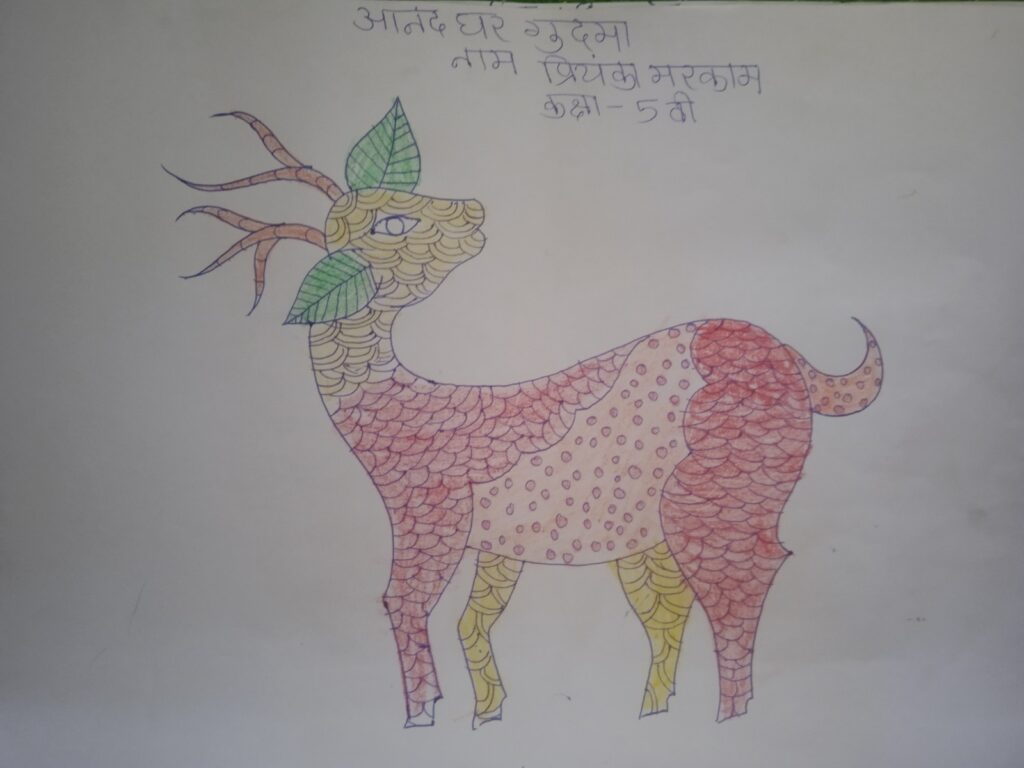
Biodiversity lessons and Gond art activities gradually began feeding into one another. Mothers slowly began joining the activities too.
When learning becomes shared
Mothers from the Mata Samitis — village-level mothers’ groups — slowly began joining activities alongside the children. During drawing sessions, somebody would begin singing a song linked to forests or seasons, and soon others would join in. Some mothers added stories. Others shared local names of plants or corrected details children had missed.
The Mata Samitis also became part of Anand Utsavs — monthly village gatherings built around songs, games, storytelling, and performances — and Bal Melas, children’s fairs centred on play and learning. Mothers joined biodiversity walks, Gond art sessions, evening Masti Ki Paathshala activities, and storytelling circles where children stayed back after school for games, songs, painting, and conversation.
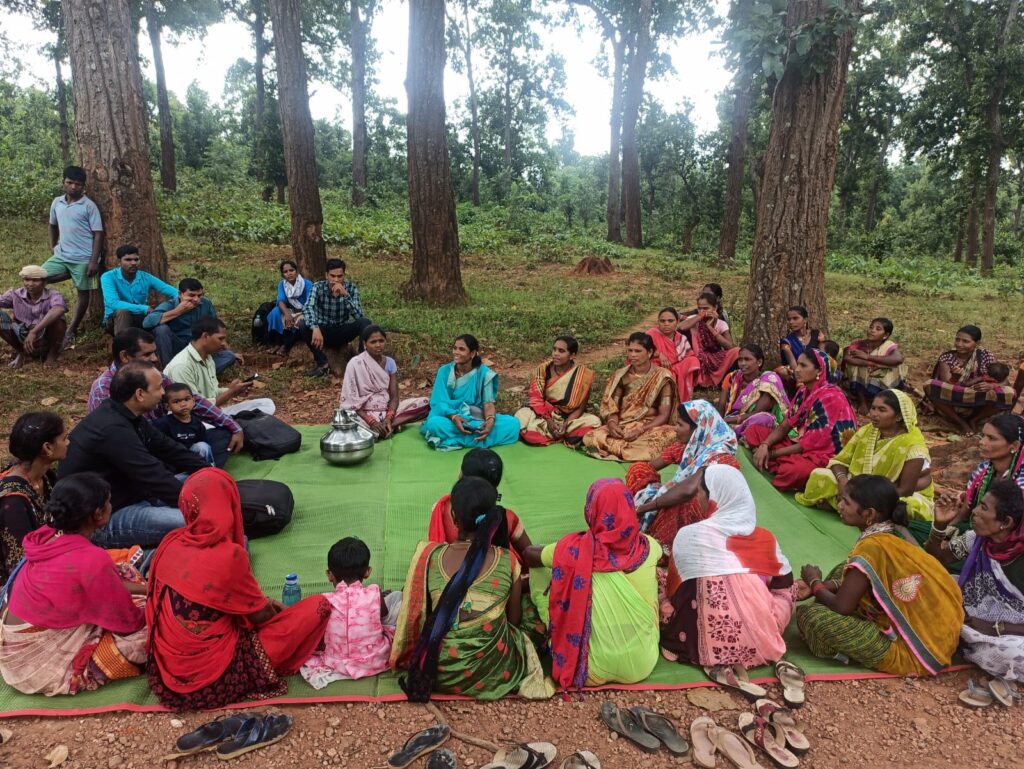
Children who once stood quietly during performances slowly began singing, dancing, and speaking more openly before larger groups. Older children often watched over younger ones during games and activities as the evenings stretched on.
When discussions continue after school
The discussions did not end when classes ended.
Children carried them home, while mothers and families brought their own experiences back into the activities.
In one household, Meena, who had learned about animal survival and water cycles, pointed out an overflowing water tank, reminding her family that the coming summer would be difficult not only for people, but also for birds and animals nearby.
Sonu stopped a branch from being cut after noticing a nesting site.
Ravi began speaking with his family about crop diversity after classroom discussions on farming practices, eventually leading them to experiment with different crops on a small section of their land.
Some families began paying closer attention to how water was stored, which branches were cut, and what was planted near the house.
Many mothers in the Mata Samitis speak with pride about children returning home and discussing birds, forests, farming, insects, songs, or local traditions long after school hours were over.
When mothers begin standing up for the school
In Bhimlat, mothers visited homes when children stopped attending regularly, speaking with families and urging them to send the children back.
In some villages, women pooled books together to create small reading corners. In others, families cleared spaces inside homes where children gathered again after school to read, draw, or revise lessons together.
As children’s interest in school activities grew, many women also began paying closer attention to the condition of the schools themselves.
Some raised concerns about damaged roofs, unsafe structures, uneven flooring, or delayed repairs. When response was found wanting, they followed up with officials and continued pressing for action.
Others became more active in village discussions connected to school attendance, activities, and children’s education. Some parents who once stayed away from school events began attending more regularly.
Children watched mothers organise meetings, visit homes, follow up on repairs, and speak with educators.
“If we don’t take responsibility, how will children’s education improve?” one mother said.
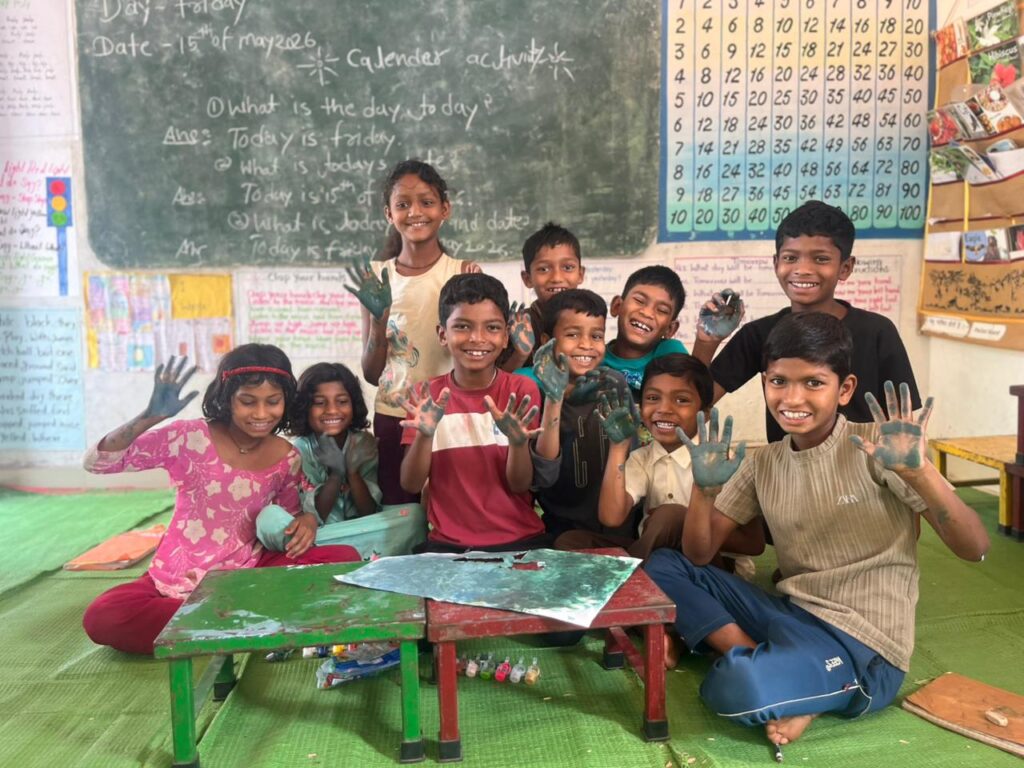
Ultimately, this biodiversity curriculum does more than teach children; it weaves the ancestral wisdom of their families with the systemic understanding needed for the future. By anchoring lessons in the familiar rhythms of the forest—from medicinal plants to seasonal changes—and integrating the active participation of the Mata Samitis, the programme transforms the school into a hub of community resilience. In Kanha, the classroom has become a space where children not only learn about their ecosystem but actively shape it. Through this bridge between traditional knowledge and scientific inquiry, a new generation of custodians is emerging, ready to protect the intricate web of life that sustains their home, their livelihoods, and their future.